
You're so Strong
Why complimenting pain tolerance isn't support

If you’d rather listen to me read this post, you can do that here:
Somewhere between yesterday and tomorrow, in the dead space that stretches for days with no hours or walls or comforts,
when it has all clearly fallen apart, and you’re caught in the wreckage,
cut open on the sharp edges,

it’s always then, in these moments, when someone steps in to say,
You’re so strong.
How heavy a mantle that is to wear.
How flattening. How one-dimensional.
How unwanted.
And, maybe in some strange way,
how laughable.

You’re so strong, they say
as my husband lies dying
a mere year after our wedding,
as the weight of my sister’s casket digs
into my shoulders,
as my father’s body disappears
into the back of a hearse.

You’re so strong—
the former human
being recast, put on display—
a statue slotted into place,
watching the world from inside this glass case.

Someone comes to dust me off once in a while.
“The Strong One.”
The golden trophy.
Indestructible.

You’re so strong.
Okay.
But what if I wanted to be something else?

Listen, I don’t want you to get the wrong idea. I’m worried you’ve skimmed this far and now you’re pissed because you think I’m saying never do that… never tell someone they’re strong.
But this is not my message.
Let me back up a moment: It’s not bad or mean to tell someone you think they’re strong. It’s okay to notice and name someone’s strength.
Quite possibly, that someone might need the reminder, might appreciate your careful noticing.
But here’s the thing: People also need to be seen and supported, and that part doesn’t always happen.
I describe this experience in The Grief House:1
As if performing the accolade, they deem you Strong, Resilient, and other things that didn’t seem like choices.
You think about what this means. About what this leaves room for and what it doesn’t.
You think about what it’s like to carry this grief teetering inside like an overfilled cup—how the liquid sits just at the brim, jostling under your throat. Threatening to spill.
You think about how it’s something that can never be set down, left at home, forgotten on a side table.
You think about how it’s not really your grief that makes it hard to find your way around. It’s other people.
They won’t give you permission to grieve.
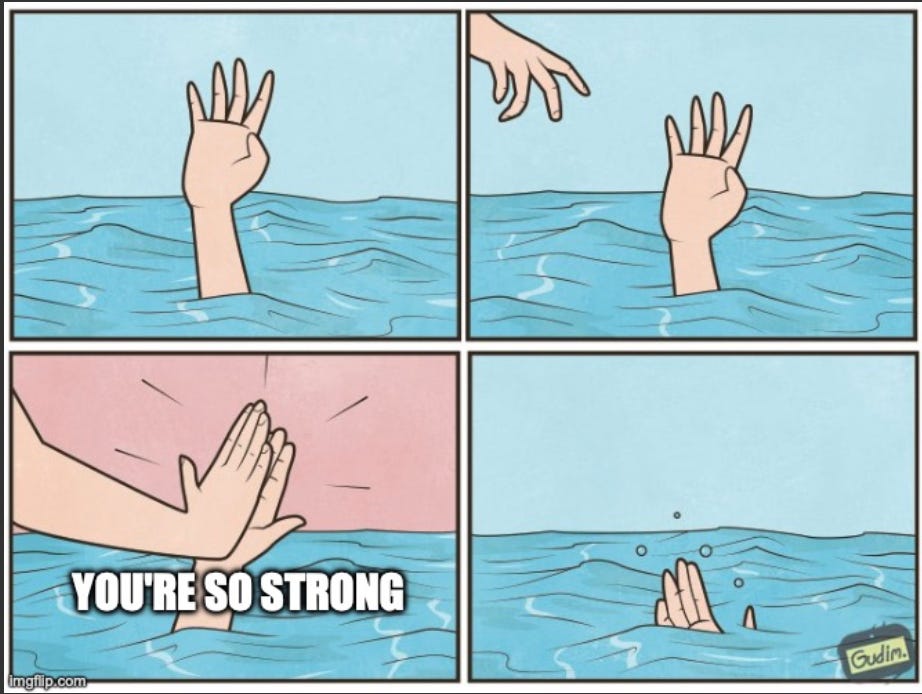
The problem with “you’re so strong” happens when it’s used to step around difficult things, to bypass suffering.
When we reduce someone’s most difficult, lonely, frightening moments to a survival story about their strength, the person inside gets lost. Erased. “The strong one” becomes recast as superhuman, as someone who doesn’t need help, as someone whose suffering can be ignored.
Ignoring suffering won’t reflect a person’s strength back to them, no matter how many times we call them “strong.”
However…
Noticing someone’s strength alongside supporting and witnessing can be helpful and encouraging. Where we want to be careful is that we don’t focus on strength without attending to pain—that we aren’t using “strong” as a sidestep or a shield because we are afraid of turning toward suffering.
It’s the difference between, “You’ve got this!” (followed by nothing else), and “You don’t deserve this. I’m not going to watch you bear this pain alone” (followed by actually showing up).
We can’t paper over pain with labels. Or I guess we can because we do that shit all the time, but the pain underneath doesn’t go away—it just leaves the person carrying it more alone.
It’s important to see, remember, and care for the whole person who exists inside their survival story.
To the bereaved, the wounded, the survivors: Some people, some family, some friends won’t ever offer genuine support or permission to grieve. Abandonment in the aftermath of grief and other hard things is devastating and horrible and far too common. It’s an awful thing to experience.
When we are living with the kind of pain that doesn’t go away, that cuts down to the soul, we need to let this hurt touch the air in the presence of caring others. We need people who are willing to see us in our strength and in our grief, our anguish, our humanity.
And those people are out there, I promise.
If “the strong one” in your life steps out of their glass case and reaches for you, hold the door open.
If they peel back their bandaid to show you a wound, take their hand in yours and say ouch… that hurts.
I’m here.

As a grieving Mom, I get this all the time. I'm not angry when people say this, but it does create a rift of sorts. Your piece is a poignant reminder that being 'strong' isn't usually a choice.
God I know! When I was going through hell, I did not feel strong. It's as if they give the baton back to you. The picture speaks volumes.